

Sharp, burning pain shooting down your leg? At My Chiropractic Place, our sciatica chiropractors in Melbourne locate the exact spinal level compressing your sciatic nerve — so your care is specific, not guesswork.

Disc herniation or disc bulging occurs when the soft inner material of an intervertebral disc pushes outward and presses directly on a lumbar nerve root, most often at L4, L5, or S1. This is one of the most common triggers of sciatic nerve pain in adults under 50.
Degenerative Disc Disease (DDD) involves gradual age-related disc narrowing, which reduces the space available for nerve roots as they exit the spine. The result is ongoing irritation and, in many cases, chronic lumbar radiculopathy.
Piriformis syndrome develops when the piriformis muscle, located deep in the gluteal region, tightens or spasms and compresses the sciatic nerve as it passes beneath it. This can mimic disc-related sciatica closely, which is why a thorough clinical assessment matters.
Sacroiliac joint dysfunction — instability or misalignment at the joint connecting the pelvis to the sacrum — can also contribute to nerve irritation and buttock pain that radiates into the leg.
Spinal stenosis is a narrowing of the spinal canal itself, creating pressure on the nerve roots that travel through it. It is more common after 50 and often causes pain that worsens with walking and eases with sitting.
Spondylolisthesis occurs when one vertebra slips forward over the one below it. This forward displacement can compress the affected nerve root, producing classic unilateral sciatica.
Vertebral subluxation — misalignment of the vertebrae in the spine — is a key focus of Gonstead chiropractic care. Subluxations can inflame the surrounding tissues and directly irritate the nerve roots that form the sciatic nerve.
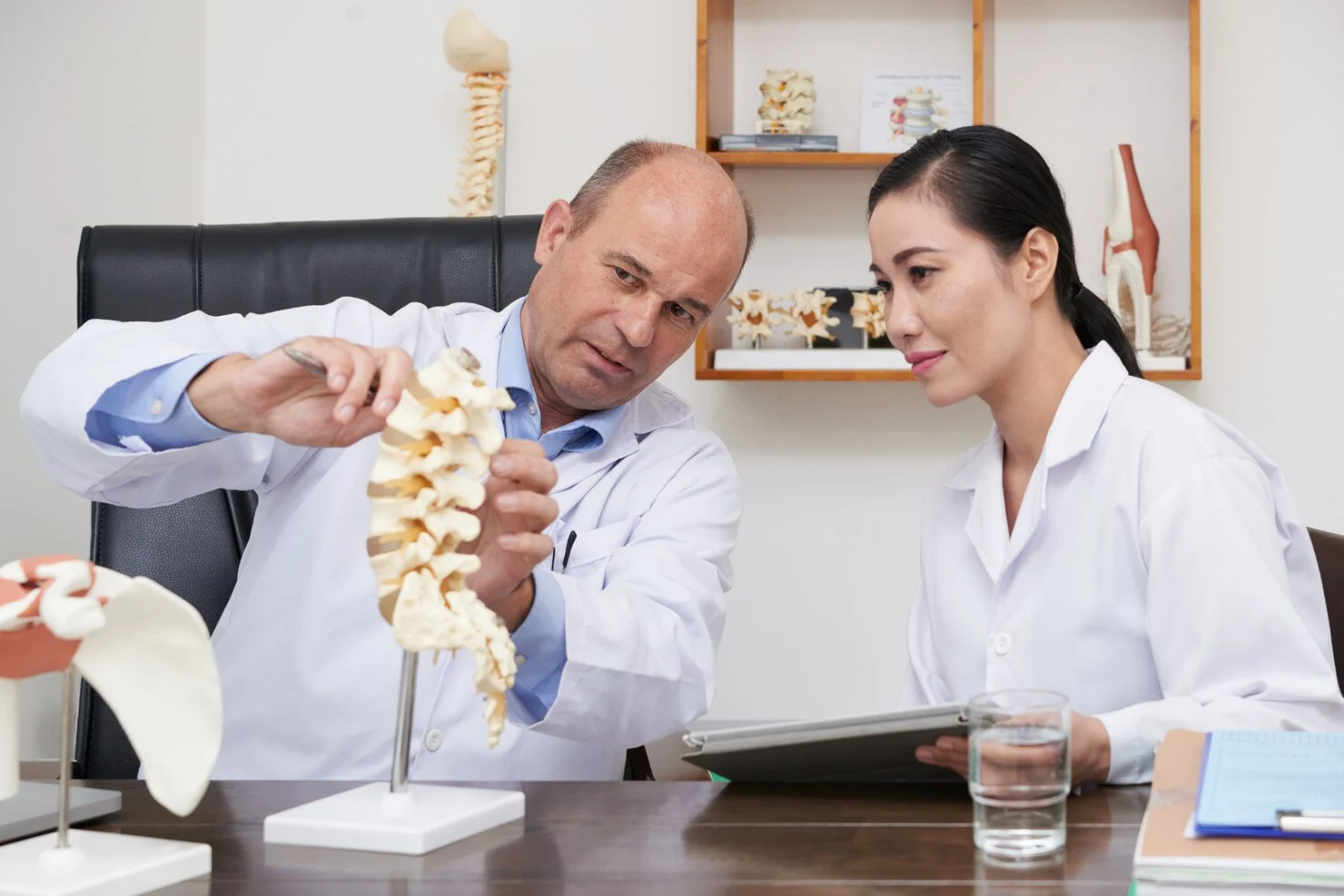
At My Chiropractic Place, sciatica chiropractor care in Melbourne begins with one thing: finding out exactly which vertebral level is responsible for your nerve compression — not simply the region where you feel pain.
Dr Nam Nguyen and Dr David Addie use the Gonstead Chiropractic System — a precise, specific method that uses case history, postural analysis, motion palpation, and spinal X-rays where clinically indicated. Between them, they bring nearly five decades of clinical experience to that assessment. That depth of experience means patterns get recognised quickly, and the analysis is thorough.
Once the affected level is identified, a targeted spinal adjustment is applied at that exact point — reducing pressure on the nerve, restoring normal joint movement, and creating the conditions for the nerve to settle and heal.
This is not a generalised approach. Every patient’s spine is different, and every care plan reflects that. You will never be placed on a prepaid chiropractic care package or pushed toward care you have not agreed to. The assessment findings are explained clearly, your options are laid out honestly, and you choose the direction that suits you.
Vertebral subluxations — misalignments of the spinal bones — can inflame and irritate the nerve roots that exit the spine and form the sciatic nerve. Research has demonstrated that subluxations induce localised inflammation along the nerve pathway, which is one of the mechanisms behind the burning and shooting pain you feel in the leg.
Studies also show that restoring movement through the affected vertebra during a spinal adjustment can reduce this inflammation and allow normal nerve function to return.
Clinical evidence consistently supports chiropractic care as an effective conservative approach for sciatica. Patients report greater pain relief, fewer days of discomfort during recovery, and a faster return to normal activity — compared to those who forgo conservative care altogether.

Given the safe, non-invasive nature of chiropractic care and the real risks associated with surgery and long-term pain medication, it makes clinical sense for most people to complete a course of conservative care before considering more invasive options.
Research shows that in cases of non-emergency lumbar disc herniation, most patients who received spinal correction reported outcomes comparable to those who underwent microdiscectomy surgery — without the recovery time, surgical risks, or cost. That is a finding worth knowing before making any significant decision about your spine.
Invasive care has its place in specific situations. If your case falls into that category, you will be told directly and referred appropriately. Honesty about what chiropractic can and cannot do is part of how this practice has operated since 2005.
Not sure what to expect? Here is how your first visit works.
Step 1 — Listen and Understand: Our chiropractor takes a thorough case history — when the pain started, what makes it worse, what helps, how it affects your sleep, work, and movement. Every detail matters because sciatica presentations vary widely from person to person.
Step 2 — Examine and Identify: A hands-on physical and neurological examination assesses your spinal alignment, nerve function, posture, and movement. Where clinically appropriate, spinal X-rays are taken to give a clear picture of what is happening at the structural level.
Step 3 — Your Care Plan, Your Choice: Your findings are explained clearly — what was found, what it means, and what your options are. Whether you want relief from acute pain, further recovery, or longer-term spinal maintenance, that decision stays with you. There are no locked-in packages and no pressure.
We see patients across our Richmond and Caroline Springs clinics, with same-week appointments typically available. You can contact the clinic directly — no referral needed, no long waits.









Sciatica is a term used to describe irritation of the sciatic nerve, the widest and longest nerve in the human body. It starts in the lower back, formed by several nerve roots as they exit the lumbar spine (L4 to S5). From there, it runs through the buttocks and down the back of each leg, eventually branching into the smaller nerves that supply your calf, ankle, and foot.
The shooting pain in your leg is your body's way of telling you that something structural — higher up the spine — is pressing on that nerve. Treating only the leg pain is like turning off a smoke alarm without looking for the fire. Finding the source is what creates lasting relief.
Yes. Chiropractors are trained to assess and help the musculoskeletal causes of sciatic nerve pain, including vertebral subluxations, disc herniations, piriformis syndrome, and sacroiliac joint dysfunction. The Gonstead System allows our chiropractors to identify the specific spinal level involved and apply a precise corrective adjustment — rather than a generalised manipulation.
This depends on how long you have had the symptoms, their severity, and the underlying cause. Acute sciatica that has come on recently often responds well within 6 to 10 visits. Chronic or long-standing cases typically require a longer plan. Your chiropractor will give you an honest, realistic picture of your timeline at your first assessment — not a vague "it depends" with nothing to anchor it.
Gonstead chiropractic is a low-risk, drug-free, non-surgical approach to sciatic nerve pain. Dr Nguyen and Dr Addie are both registered chiropractors and conduct a thorough clinical assessment before any treatment begins, including screening for contraindications. Your safety and suitability for care are assessed before anything else.
Lower back pain stays in the lower back. Sciatica travels — it radiates from the lumbar spine through the buttock and into one leg, following the sciatic nerve pathway. You may also notice tingling, numbness, or weakness in the leg or foot, which is not typical of straightforward lower back pain. A clinical assessment can clearly differentiate the two and guide the right approach for each.
Yes. Both our Richmond and Caroline Springs clinics offer sciatica assessment and Gonstead-based chiropractic treatment. Dr Nguyen has been practising in Caroline Springs since 2007 — he was the first chiropractor to serve that community — and both locations operate with short waiting times by design. Book at whichever clinic is most convenient for you.
Sciatica is not something you simply have to push through. When the nerve compression is identified and addressed at the source, the difference can be significant. Dr Nguyen and Dr Addie, with nearly 49 years of combined chiropractic experience between them, have helped many Melbourne patients move past the kind of leg pain that was disrupting their sleep, their work, and their daily life.
Book a sciatica assessment at the clinic that suits you best. No referral, no prepaid plans, and no pressure — just a clear picture of what is going on and your options for moving forward.
Barge, F. H. (1995). The chiropractic vertebral subluxation and its relationship to vertebrogenic lumbar pain, cruralgia and sciatic syndromes. Chiropractic Research Journal, 3(2), 25-39.
Bejia, I., Younes, M., Zrour, S., Touzi, M., & Bergaoui, N. (2004). Factors predicting outcomes of mechanical sciatica: a review of 1092 cases. Joint Bone Spine, 71(6), 567-571.
Bergmann, T. F., & Jongeward, B. V. (1998). Manipulative therapy in lower back pain with leg pain and neurological deficit. Journal of manipulative and physiological therapeutics, 21(4), 288.
Colloca, C. J., Keller, T. S., & Gunzburg, R. (2004). Biomechanical and neurophysiological responses to spinal manipulation in patients with lumbar radiculopathy. Journal of manipulative and physiological therapeutics, 27(1), 1-15.
Cox, J. M., & Shreiner, S. (1984). Chiropractic manipulation in low back pain and sciatica: statistical data on the diagnosis, treatment and response of 576 consecutive cases. Journal of manipulative and physiological therapeutics, 7(1), 1.
Kirkaldy-Willis, W. H., & Cassidy, J. D. (1985). Spinal manipulation in the treatment of low-back pain. Canadian Family Physician, 31, 535.
Maxwell, T. D. (1978). The piriformis muscle and its relation to the long legged sciatic syndrome. The Journal of the Canadian Chiropractic Association, 22(2), 51.
McMorland, G., Suter, E., Casha, S., du Plessis, S. J., & Hurlbert, R. J. (2010). Manipulation or microdiskectomy for sciatica? A prospective randomized clinical study. Journal of manipulative and physiological therapeutics, 33(8), 576-584.
Orlin, J. R., & Didriksen, A. (2007). Results of chiropractic treatment of lumbopelvic fixation in 44 patients admitted to an orthopedic department.Journal of manipulative and physiological therapeutics, 30(2), 135-139.
Saal, J. A. (1996). [black small square] Natural History and Nonoperative Treatment of Lumbar Disc Herniation. Spine, 21(24S), 2S-9S.
Santilli, V., Beghi, E., & Finucci, S. (2006). Chiropractic manipulation in the treatment of acute back pain and sciatica with disc protrusion: a randomized double-blind clinical trial of active and simulated spinal manipulations. The Spine Journal, 6(2), 131-137.
Stern, P. J., Cote, P., & Cassidy, J. D. (1995). A series of consecutive cases of low back pain with radiating leg pain treated by chiropractors. Journal of manipulative and physiological therapeutics, 18(6), 335.
Tachihara, H., Kikuchi, S. I., Konno, S. I., & Sekiguchi, M. (2007). Does facet joint inflammation induce radiculopathy?: an investigation using a rat model of lumbar facet joint inflammation. Spine, 32(4), 406-412
Vroomen, P. C., de Krom, M. C., Wilmink, J. T., Kester, A. D., & Knottnerus, J. A. (1999). Lack of effectiveness of bed rest for sciatica. New England journal of medicine, 340(6), 418-423.